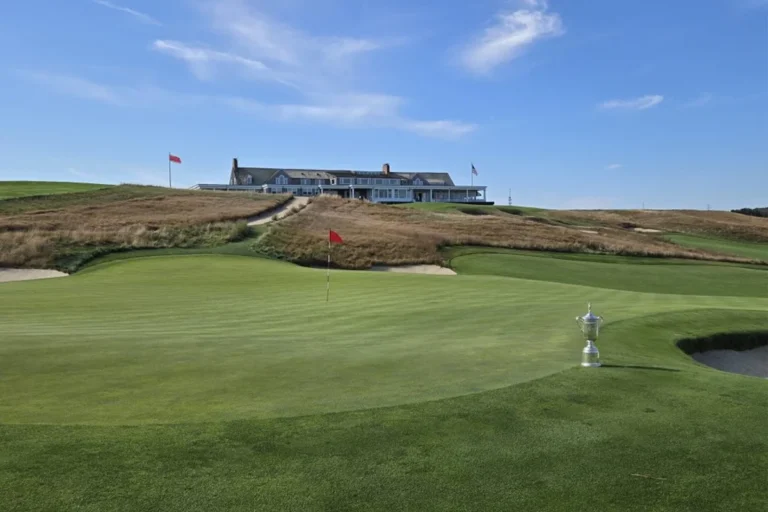
Golf Digest writer Josh Sens reached out to me ahead of the 2026 U.S. Open at Shinnecock Hills to discuss William Flynn’s life and work. Given that Shinnecock Hills is widely regarded as Flynn’s greatest design, and that the course will once again be on full display before the world’s top professionals, I was delighted to have the opportunity to speak to Flynn’s genius to a broader audience. Flynn is, in my estimation, one of the finest golf course architects of all time, and yet he remains far less celebrated than many of his contemporaries. I hope this conversation goes some small way toward correcting that.
Q. When did you first become interested in Flynn’s work and what drew you to it?
Living in the suburbs of Philadelphia had a lot to do with my initial interest in Flynn given there are 28 courses in the greater Philadelphia region with Flynn’s design, redesign, or agronomic input. While a member at Rolling Green Golf Club and now Merion Golf Club, I played in many Golf Association of Philadelphia inter-club matches. I would generally play the away matches to sample other courses in the area. I liked to learn the name of the golf course architect on any given course. Not unsurprisingly, many of my competitors had no idea who designed their course. Upon investigation, it became clear that my favorite courses in the area were designed by William Flynn. I didn’t know much about him. He was not nearly as well-known as Tillinghast, MacKenzie, or Macdonald/Raynor.
So, I started to research Flynn in the mid-1990s. At the time, I was commuting daily from Merion to New York City for work and got bored with crossword puzzles and cryptograms and thought I’d take a stab at writing. I wrote a screenplay – an adaptation of a Sherlock Holmes story, but that didn’t go anywhere. As my interest in golf course architecture grew, I decided to write a book on William Flynn. There wasn’t a lot to find on the internet those days. I contacted a family friend, Jim Finegan, the outstanding golf writer, and sought his advice. He gave me some insights into research methods and had me contact golf architect David Gordon, the son of William Gordon – a golf architect and former construction foreman for Toomey and Flynn, the construction and engineering company that built most of Flynn’s designs.
Gordon sent me a box of original Flynn plans and that was the foundation for the work that has produced, to date, the 2626-page bio, The Nature Faker – William S. Flynn, Golf Course Architect.
Q. Flynn was famously part of the Philadelphia School of design. For those unfamiliar, what were the central principles of that school and how, if at all, did they differ from those of other great architecture of the time?
The so-called Philadelphia School of Golf Course Architecture emanated from the lopsided losses Philadelphia golfers faced from the inter-city competitions between Philadelphia, New York, and Boston in the Lesley Cup matches. Philadelphia was late to golf – it was the country’s bastion of cricket. Even the growth of baseball was delayed in acceptance due to how deeply cricket was ingrained in the region. The Merion and Pine Valley tests of golf, which continue to stand the test of time, are the earliest examples of championship golf design. The friends that comprised the Philadelphia School included Hugh Wilson (Merion), George Crump (Pine Valley), A. W. Tillinghast (Philadelphia Cricket Club), George Thomas (Los Angeles Country Club), and William Flynn (Shinnecock Hills Golf Club) were a collection of visionary golf course architects and turf grass specialists. It could also be called the Pennsylvania School given that William Fownes (Oakmont Country Club) was also a Pine Valley member and had an influence.
The friends that made up the “School” strived to develop championship courses with the idea that championship course designs will yield better champions. The collaboration can be found at Merion Golf Club, Pine Valley Golf Club, and the city’s first municipal course, Cobbs Creek Golf Club.
Rather than penal layouts characteristic of Victorian era architecture – geometric design elements – with specific challenges to avoid central hazards. The Philadelphia architects promoted courses that provide physical tests for shot execution and strategic planning to account for multiple ways to play the course. The Philadelphians are known for the utilization of natural site-specific features in their routings. They weren’t focused on finding sites where template hole designs could be placed. They were unbounded by Old World convention while taking care to make architectural features look natural. They knew that avoiding overly artificial mounding, green sites, and geometric bunkers reduced ongoing maintenance costs, pioneering sustainability and environmental conservation. The best efforts by the Philadelphians offer a variety of hole lengths, specific shot testing, and angles that require careful strategic planning.
Q. As for Flynn himself, what, if anything, distinguished him from his colleagues? Anything that stands out about his work to the point where a layperson, looking at a course, might be able to say, Aha, yes. That’s a telltale sign of a Flynn design? (One of the shortcomings of golf writing, my own included, I think, is that descriptions of architecture often have a certain sameness to them — lay of the land, risks and rewards, variety, options, etc. Anything else we can say about Flynn beyond that kind of language that differentiates him from his contemporaries?)
Flynn was truly one of a kind.
- He provided a one-stop shop for his golf course clients – architecture, construction, turfing, and maintenance practices.
- He was arguably the finest router of golf courses.
- Flynn spent a lot of time on site, with design iterations that were tried on paper before being produced on the ground. His plans were expected to be built precisely according to the detailed construction instructions Flynn provided. None of the construction teams were allowed to deviate in the slightest from Flynn’s final plans. Overlaying Flynn’s plans on top of historic aerials clearly shows that the courses were built to the plans rather than the plans being after the fact as built.
- He produced unique site-specific hole designs.
- He was a master at designing perceptual miscues to put golfers off balance.
- He was the first to provide multiple tees for use on a given day, each to be played by golfers with the appropriate skill set.
- He planned elasticity into his designs so that lengthening over time was possible given the advances in golfers and technology. In 1927 he prophetically wrote that if something was done about the ball, architects would have to start building 7,500 to 8,000-yard courses.
- He promoted the use of triangulation to increase the effect of wind and did so at 20 of his courses.
- He did not believe in replicating hole concepts from the Old World on American designs.
- Flynn’s green designs take a long time to learn; they don’t rely on overt internal contouring as much as long interplays of slope
- Flynn’s design theories evolved over time. From the mid-1920s onward, Flynn often utilized short grass areas around greens so that missed approaches would trundle further away from the green offering a variety of recovery shots.
Flynn believed in natural aesthetics in all architectural elements, including tee shapes (no squared-off corners), bunker shapes – mimicking natural seaside bunkers, and greens.
Q. Shinnecock is widely regarded as his greatest design. What makes it so special?
Flynn was tasked with creating a championship test of golf that would be enjoyable for all classes of golfers – the most difficult of design challenges. Shinnecock Hills was late in his career, just after the onset of the Great Depression and prior to the halt in golf course development due to WWII. All of the above elements that confirm Flynn as one of the finest golf course architects of all time are on full display at Shinnecock Hills. The amount of triangulation, warranted on a large and windy site is greatest at Shinnecock Hills with three sets of triangles comprising 10 holes: 4-5-6. 10-11-12-13, and 14-15-16.
It provides a stern test for the touring pros and enjoyable difficulty for all classes of players that play from the proper tee. The design allows ground game options on some holes 1, 2, 3, 4, 5, 6, 8, 12, 14, and 18 and specific aerial demand shot tests on others (7, 9, 10, 11, 13, 15, 16, and 17).
Q. Aside from the greatness of the site itself, was there anything different or notable in how Flynn approached that job? Did he spend more time on site than he did at others? Employ a different crew? Was he given freer rein there than at other projects?
Unlike some of his peers, Flynn did not forsake quality for quantity. He only worked on a few projects at a time, nearly always with the same construction crew that knew what Flynn wanted and delivered. Spending a considerable amount of time on site yielded design nuances that other architects couldn’t provide. Flynn would utilize distant features and replicate them on the grounds. This created a harmony with the surroundings that resonates with golfers whether or not they recognize the effect.
Q. For fans watching the U.S. Open this week, are there any holes that stand out as especially compelling or particularly representative of Flynn’s style? Or, put in a different way, which holes at Shinnecock do you personally find most interesting and why?
The Shinnecock Hills golf course is made up of 18 great holes. There isn’t a hole that lacks interest. This makes it difficult to highlight a few holes that are representative of Flynn’s design theories and practices. I’ll take a crack at some of the holes that are indicative of Flynn’s design theories.
Hole 1: The offset fairway requires that the first shot of the round be on the correct line and have the correct distance. Try to take on too much and be short, you’re in the right rough. Take on too little and the tee shot ends up in the left rough. From the rough, approach shots to this green that sheds balls front, back and along the sides is very challenging.
Hole 5: This long par 5 hole offers a split fairway with longer hitters able to play down the left side. Shorter hitters playing safe to the right fairway have a much tougher angle into the green given a massive right fairway bunker. Approach shots from the left can either be played in the air or on the ground with the left to right slope short of the left side of the green feeding running shots onto the green.
Hole 7: Flynn, along with Harry Colt, were the two best designers of par 3 holes. The collection of par 3 holes at Shinnecock Hills is particularly strong. The original Macdonald Redan hole (his 14th) was laid out over the natural right-to-left slope of the ground. The tee was above the Macdonald green. Flynn raised the green some 4 to 5 feet, requiring an aerial shot due to the steep upslope fronting the green. Flynn proposed a new tee 7 paces to the left of the Macdonald tee. This small difference in approach angle allows a greater range of shot trajectories, including a slight draw. This is not possible from the original Macdonald tee.
Hole 8: Flynn often challenged the golfer’s ability to survey the hole design and plan a strategy to provide the best scoring possibility. The 8th hole is a great example whereby Flynn tests the golfer’s ability to understand the demand the architect is presenting. Most of Flynn’s contemporaries rewarded play that takes the shortest route on dogleg holes; cutting the corner. Flynn laid out the fairway, bunkers, and greens in such a manner that dictates the ideal angle of play is along the outside of the dogleg. Making such holes play longer than their scorecard length.
Hole 10: Flynn gives you something to think about on the blind tee shot 10th. A decision needs to be made whether to lay up short of the downslope and stay on the plateau even with the elevation of the green with a longer approach or play down to the hollow with a steep upslope approach shot. The short approach hit with too much spin can come back to you. A shot that is too long will run down the back slope off the green resulting in a scary recovery shot with the front of the green falling away from you.
Hole 11: This celebrated short par 4 has a green placed precariously on a ridge. The opening to the green was fashioned by cutting into the left-to-right slope. Any shot missed right, left, long, or short is repelled away from the green, often into deep bunkers. This precise aerial shot demand hole is worth viewing up close as the scoring spectrum tends to be very wide – birdies to double bogeys or worse are possible. Wide scoring spectrums are often indicative of outstanding design. It certainly is the case with the short 11th at SHGC.
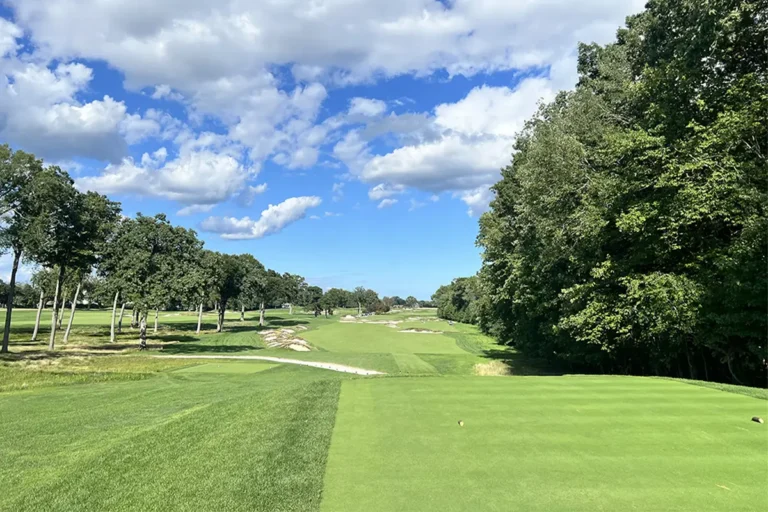
Hole 14: Similar in a number of ways to the 6th at Merion Golf Club’s East Course, the long par four 14th sits in a valley between two slopes. The hole exhibits challenge throughout, from the demanding tee shot to the demanding long uphill approach, to the tricky green.
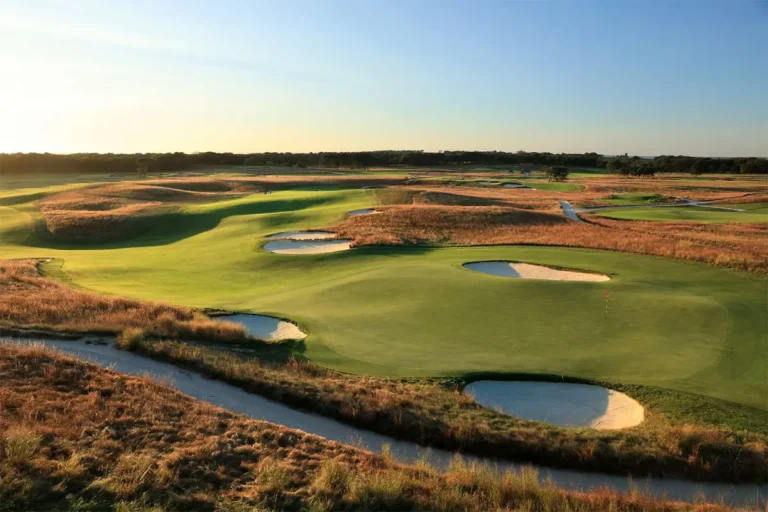
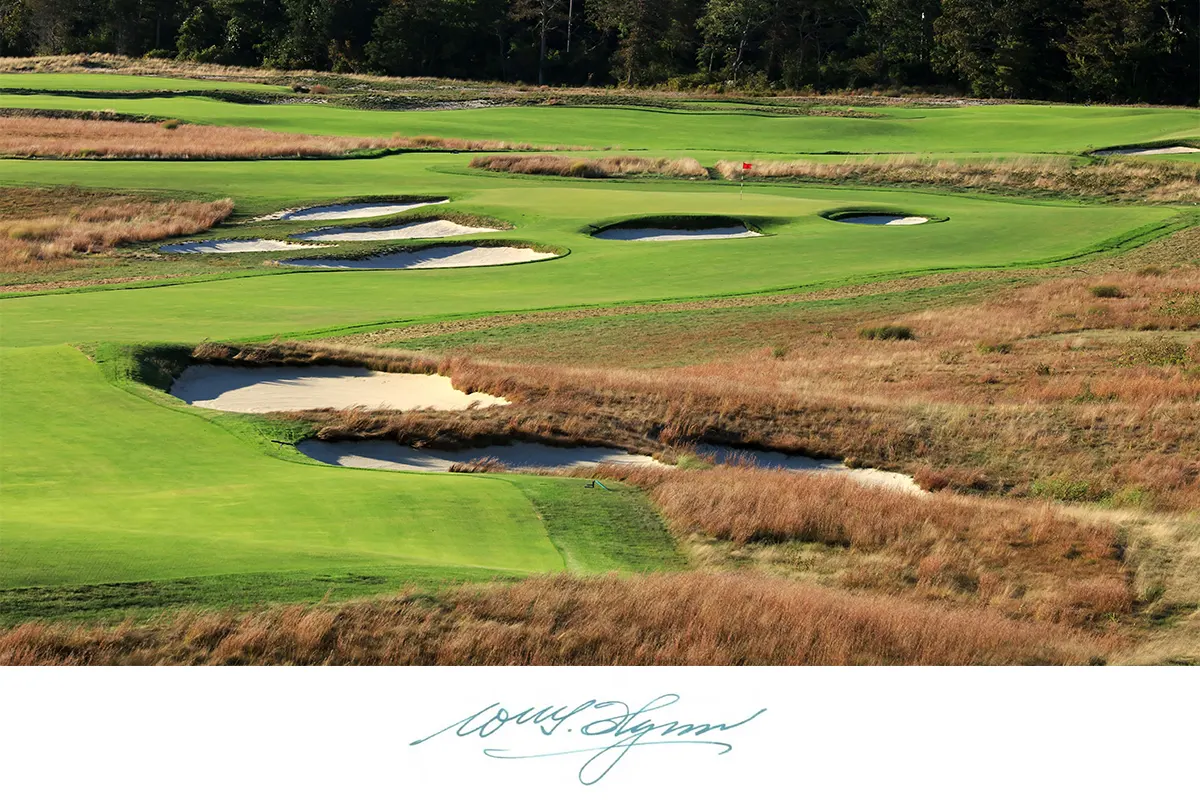
Hole 16: This is one of the finest par five holes in the US. The hole runs in a straight line from tee to green, yet the fairway is actually a double s-curve tacking around a series of bunker complexes, ending up with an aerial approach shot demand. It is difficult to read the subtle breaks of the green.
Q. At the time of Flynn’s death, did he have other notable projects in the works? Any plans that he left unfulfilled?
Great question. Flynn died on January 24, 1945, nine months prior to the end of WWII. The Great Depression and the economic boom that resulted from the war was not yet in effect. There was very little going on in terms of golf course development. Flynn finished the design and construction of the US Naval Academy golf course, the redesign of the Langston Golf Course, a municipal course in Washington, DC. His last projects, all in the Maryland/DC area, included the design of the Indian Spring Country Club course, the design and redesign of the East Potomac Park municipal golf course, and the design and redesign of the Rock Creek Park municipal golf course. I am not aware of any pending projects that would’ve started up at the end of the war.
Q. Among our readers, I think it’s fair to say that Flynn is not as widely recognized a name as some other accomplished architects of his era. Is it fair to say that he is underappreciated? If so, why do you think that is the case? Because he died young? Anything about his personality or the projects he worked on that drew less public attention?
Well, given that I think Flynn is one of the top architects of all time, and most people have never heard of him, I think it is a fair statement to say he is underappreciated. Some of that is due to a lack of understanding of his significant roles at Merion, Pine Valley, The Country Club in Brookline, and Kittansett Club. Another contributing factor is that Red Lawrence mistakenly took credit for the innovative design of Indian Creek Country Club and Dick Wilson took credit for the design of the Shinnecock Hills Golf Club course. Flynn alone was responsible for these celebrated designs. Howard Toomey was the managing partner of Toomey and Flynn, Construction Engineers. He had no architectural influence. Red Lawrence and William Gordon were construction foremen. Dick Wilson was under Lawrence and Gordon. He never had a construction foreman role. Once when Gordon was sick, Wilson took over during Gordon’s recovery period. He deviated from Flynn’s plan for a green and was sacked on the spot when Flynn got back. It took Gordon and Wilson’s brother Wayne to convince Flynn to hire him back. The Wilson green was undone, and a faithful rendition of the Flynn plan was built.
Flynn died young, due to chronic nephritis and diabetes. The nephritis could well have been the result of long-term exposure to harsh chemicals used in the maintenance of golf courses such as arsenate of lead. Much of his career was stymied by the Great Depression and WWII. It is interesting to think what Flynn’s stature in golf would be if these 15 or so years could have provided more work for Flynn.
Flynn’s portfolio of designs has a lot to do with the relative lack of appreciation for Flynn. He did very few public courses, and many of the resort courses built or planned in Florida were undermined by hurricanes, land bubbles, the Great Depression, and WWII. Flynn’s courses tend to be very private and are geographically concentrated in SE Pennsylvania. His courses are typically the elite courses in a given area with little outside play. Yet, 105 USGA events have been held on courses with some level of Flynn contributions with another18 planned. Flynn courses have also held 3 PGA championships. Classic era architects with much larger portfolios have had many less championships. Donald Ross courses have held a few more championships, but he designed 5-6 times as many courses.
A great number of Flynn’s revolutionary designs no longer exist, including Boca Raton South, Mill Road Farm, Opa Locka, the Pocantico Hills course on the Rockefeller estate in Westchester, NY, and the two Yorktown Country Club courses.