
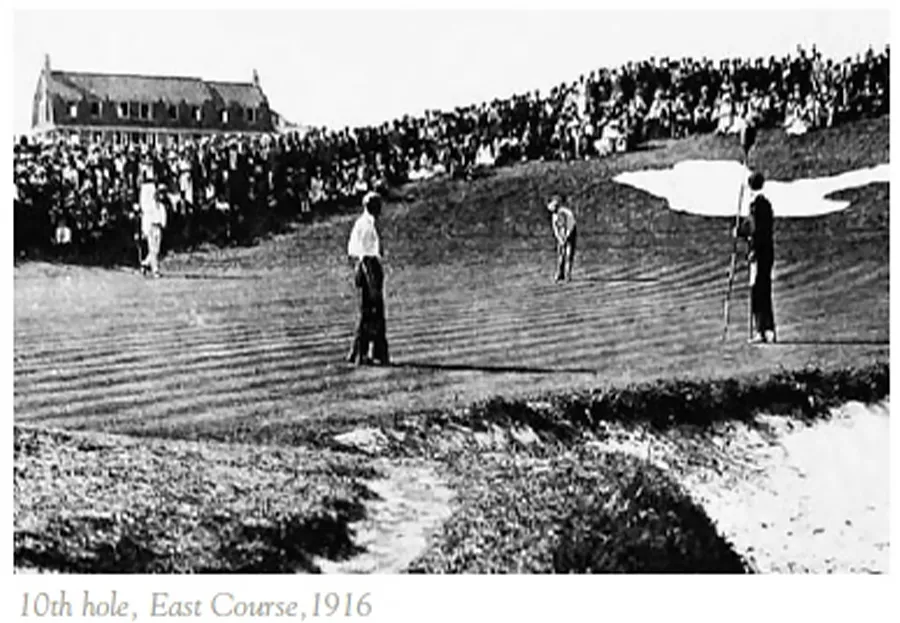
Playing along the old golf grounds of Merion Golf Club’s East Course, one cannot escape the sense that it is a uniquely enjoyable golf experience. Can one analyze the assembled components, which together manifest the overall experience? With the veil of mystery set aside, does the solution to the puzzle lessen the quality of the experience? In analyzing the architectural underpinnings of the Merion East golf course, it is the opposite which occurs. There is born of such an understanding a greater appreciation of the component parts assembled into a greater whole. So what are some of these component parts which add up to the architectural achievement we experience today?
Natural Aesthetic
Superintendents hope that golfers walk off the last green thinking to themselves that they’ve played the perfect golf course. For most players that means monochromatic greens and fairways with a lush green color and rough that is uniform and fair. Such uniformity is unheard of in nature and, of course, golf is not a game of fair. Matt Shaffer, director of golf course operations, shares his thoughts:
“American golf has moved dramatically away from what I like to call edginess. Per-haps it is because everyone is concerned with the way the course will look on TV. Merion is edgy and we will not look perfect on TV nor would we want to be perceived that way! Our roughs will be blotchy because we have 10 different varieties of grasses out there, not one perfectly homogenous variety that every single shot will play the same. We do have grain in our greens because we purposely chose the old stoleniferous varieties. Our bunkers are to be feared not because they are a better option than our rough, just because they are what they are A HAZARD! Will they be perfectly level—they better not be! Our tees aren’t level, our fairways have grain going in every single direction. Is this because Matt Shaffer made it this way? Of course not. GOD made Merion the way it is—less than perfect!”
Golf in America was firmly rooted in the last two decades of the 19th century. The theory and practice of golf architecture would probably surprise many golfers today. There were few, if any, strategic demands. It was hard enough for beginning golfers to get the ball airborne with hickory clubs and gutta percha golf balls.
Many golf clubs began as riding and polo clubs, so the resemblance of features on the courses to steeplechase obstacles is not surprising.
In an era without steam power or combustion engines, many early American golf courses utilized man-made features which were rather simple, often geometric in design. Consider the raised bunker within a green at Huntingdon Valley Country Club and the zigzag hazard at Shinnecock Hills Golf Club.
Click Here to Open the Full Newsletter